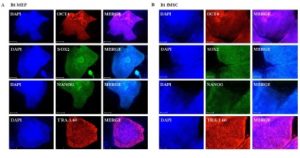
Culturing Human Pluripotent Stem Cells Using Human Fetal Femur Derived Mscs and Mouse Embryonic Fibroblasts: A Comparative Study

Numerous studies have shown the successful use of human stromal cells as feeders for the propagation of pluripotent stem cells. In this study, we
investigated the use of human fetal femur-derived mesenchymal stem cells (fMSCs) as an alternative to MEFs. We comparatively cultured over several
passages hESCs and iPSCs on fMSCs and MEFs as feeder layers as well as conditioned medium (CM) produced from both cell types. A quality check
for CM is the concentration of secreted Activin A, which is known to support self-renewal of pluripotent stem cells. The level of Activin A in fMSC-CM
was higher compared to MEF-CM when prepared under identical conditions. Furthermore, fMSCs secrete numerous factors amongst these are FGF2,
FGF19, VEGF, PDGF-AA, IL-11 which are involved in proliferation processes. The current study demonstrates that human fMSCs provide several
advantages over MEFs and can be used as an alternative for routine propagation of pluripotent stem cells. Use of fMSC obviates the unnecessary
need for breeding mice solely for the production of MEFs, therefore addressing the important issue of animal usage for MEF generation and most
importantly avoids the risk of contaminating human cells with mouse pathogens.


View Full Article: HERE

Go through the Journal: http://www.enlivenarchive.org/stem-cell-research-regenerative-medicine

Contact Us: stemcell-research@enlivenarchive.org
Potential Cancer Prevention and Treatment by Silencing the Killer Cell Immunoglobulin like Receptor Gene in Natural Killer Cells Derived from Induced Pluripotent Stem Cells

Cancer immunosurveillance is an important host protection process, monitoring the presence of irregular cells that could potentially transform into tumor cells, effectively clearing the body of transformed tumor cells at their earliest stages, and thus maintaining regular cellular homeostasis. Natural killer(NK) cells are effector lymphocytes of the innate immune system, playing a critical role in surveillance for tumor cells, while also eliminating virally infected cells. The significance of the anti-tumor role of NK cells was recently further verified by findings that immunosuppression in most cancer patients is not perceptible until late stages. NK cells express the low-affinity Fc-activating receptor, CD16, and the inhibitory receptor, killer cell immunoglobulin-like receptor (KIR). Consequently, activation of NK cells is determined by the balance of inhibitory and activating receptor stimulation. Here, we propose establishing an induced pluripotent stem cell (iPSC)-derived NK cell line with KIRgene knockout or knockdown as a possible regimen to treat and prevent cancer. We further postulate that an optimal mixture of NK iPSCs with and without KIR gene knockout, would reach a maximum antitumor activity, with minimal side effects. We also discuss the possible advantages of KIR-knockout NK iPSCs for adoptive immunotherapy in patients with cancer.


View Full Article: HERE

Go through the Journal: http://www.enlivenarchive.org/stem-cell-research-regenerative-medicine

Contact Us: stemcell-research@enlivenarchive.org
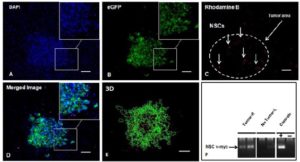
 

Intranasal Delivery of Therapeutic Neural Stem Cells to Target Intracerebral Glioma

Despite aggressive multimodal therapy and advances in imaging, surgical and radiation techniques, high-grade gliomas remain incurable, with patient
survival often measured in months. Treatment failure is largely attributable to the invasive nature of glioma cells, ineffective delivery of chemotherapeutic
agents across the blood-brain barrier, and dose-limiting systemic toxicities. Neural stem cells (NSCs) have inherent tumor-tropic properties that can be
exploited for targeted delivery of anti-cancer agents. However, current intracranial and intravenous injection approaches for administering NSCs are
not optimal, especially for repeat administrations, because the methods are invasive and may lead to complications.


View Full Article: HERE

Go through the Article: http://www.enlivenarchive.org/stem-cell-research-regenerative-medicine

Contact Us: stemcell-research@enlivenarchive.org
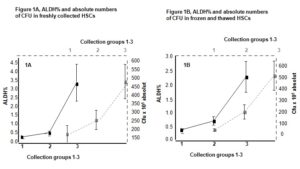
 

Aldehyde Dehydrogenase Activity may Replace Colony Forming Units as A Quality Marker in Hematopoietic Peripheral Stem Cells Collections

Background and Objectives:
In daily routine stem cell harvests for stem cell transplantation are measured by CD34 antigen and the colony-forming ability (CFU) and checked for viability by 7-amino actinomycin D (7-AAD). We tested whether the stem cell marker ALDH could be useful for characterizing PBSC graft quality.


View Full Article: HERE

Go through the Journal: http://www.enlivenarchive.org/stem-cell-research-regenerative-medicine

Contact Us: stemcell-research@enlivenarchive.org
Understanding Vascular Biology with the Help of Endothelial Progenitor Cells

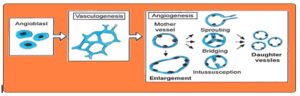
Peripheral blood of adults contains low levels of a subtype of progenitor cells that have the capacity to differentiate into mature endothelial cells and hence they are termed as EPCs (Endothelial Progenitor Cells). These cells have the potential to perform neo-vascularization and re-endothelialization of the injured tissue. Bone marrow of adults contains a reservoir of these progenitor cells which can migrate to the peripheral circulation on receiving the appropriate stimulus and thus perform the necessary functions apart from differentiating to mature endothelial cells. Most of the literature states that isolation and selection of EPCs can be performed from different sources by adherence culture and magnetic microbeads. EPCs are normally characterized by the presence of three-antigen combination of CD34, CD133 and VEGFR2. However, when migrating to the circulation i.e. during differentiation, these progenitors start to lose CD133 and begin to express endothelial specific markers like CD31, VE-cadherin and vWF. In context of therapeutic application of these cells, there are few clinical trials which have started to employ EPCs for treating various ischemic diseases though there has been inconsistency in the clinical outcome. Hence, further and deeper understanding in the field of EPCs can bring about a general consensus on their specific identity along with their mechanisms of homing and differentiation which are largely unclear at present. This review summarizes the role of EPCs in some of the major diseases, their isolation, characterization and functionality assays, mechanisms of homing and differentiation along with their circulating levels in vivounder certain conditions and factors.


View Full Article: HERE

Go through the Journal: http://www.enlivenarchive.org/stem-cell-research-regenerative-medicine

Contact Us: stemcell-research@enlivenarchive.org

Stem Cell Strategy for the Treatment of Motor Neuron Diseases

Motor Neuron disease is a neurodegenerative disease of central nervous system leading to death of motor neurons from CNS and spinal cord. Due to the lack of effective treatment modalities, recently, many scientists have considered stem cells as a potential strategy for the treatment of this disease. Amongst the different types of stem cells, MSCs have been thought as a promising source of stem cells in regenerative medicine applications. These cells can be transplanted into the injured nervous system as a new therapeutic strategy. Although many challenges and concerns still remain, and the exact mechanism by which stem cells act is still unknown, the positive effect of stem cells following transplantation has encouraged many researchers to consider this as a treatment option in the future. There has been a lot of research ongoing on the derivation of motor neurons from stem cells in vitro and many scientists are attempting to bring these cells into clinical applications by conducting a number of clinical trials. Here, in this review, we discuss the current progress in pre-clinical studies and the status of clinical trials using stem cells in motor neuron diseases. We also discuss the hurdles which need to be overcome while moving from bench to bedside. Based on current information available, stem cell derived motor neurons can pave the way as a new treatment option for patients with the disease which seems to be highly promising.


View Full Article: HERE

Go through the Journal: http://www.enlivenarchive.org/stem-cell-research-regenerative-medicine

Contact Us: stemcell-research@enlivenarchive.org


Stem Cells – A Promise to Elixir

Stem cells are pluripotent cells which are having properties to differentiate into different lineages of cells types. Recently stem cells have been doubted in regards of their curative abilities of several diseases. The increasing number of difficulties to treat diseases versus the wait for promising cures creates restlessness among clinicians and patients.


View Full Article: HERE

Go through the Journal: http://www.enlivenarchive.org/stem-cell-research-regenerative-medicine

Contact Us: stemcell-research@enlivenarchive.org

Does Ultrapure Dialysis Fluid Improve Quality of Life in Hemodialysis Patients?

Introduction: Use of ultrapure dialysis fluid (UPDF) may offer hemodialysis patients advantages over conventional dialysate, including reduced infection risk, preserved residual kidney function, improved nutrition, reduced inflammation and improved anemia. In 2011, a new standard was published which defined differences between standard dialysis fluid and ultrapure dialysis fluid. It’s unclear if these advantages will be seen if UPDF is widely adopted.


View Full Article: HERE

Go through the Journal: http://www.enlivenarchive.org/nephrology-and-renal-studies-open-access

Contact Us: nephrology-renalstudies@enlivenarchive.org

Risk Management and Quality Assurance Parameters in One Hemodialysis Center: A Clinical and Patient Care Attitude

Introduction and Aims:
In developed countries, 0.07% of population receives chronic hemodialysis. This number is expected to rise. This demand renders risk management
and quality control essential for dialysis management.


View Full Article: HERE

Go through the Journal: http://www.enlivenarchive.org/nephrology-and-renal-studies-open-access

Contact Us: nephrology-renalstudies@enlivenarchive.org