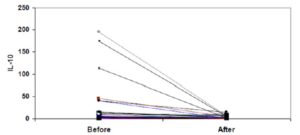
IL-10 Human Gene Polymorphism and Clinicopathological Diversity and Treatment Response in Egyptian Patients with Lupus Nephritis

Background and Aim of Study:
Interleukin-10 (IL-10) is an important immunoregulatory cytokine. Many studies suggesting that a genetically controlled high innate IL-10 production
may predispose to systemic lupus erythematosis (SLE) development. The aim of our study was to investigate IL-10 gene -592 A/C polymorphism
in Egyptian patients with SLE and lupus nephritis (LN) and evaluate the role of lL-10 in the pathogenesis and clinical/pathological diversity of LN.


View Full Article: HERE

Go through the Journal: http://www.enlivenarchive.org/nephrology-and-renal-studies-open-access

Contact Us: nephrology-renalstudies@enlivenarchive.org

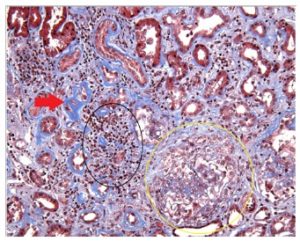
Atypical Presentation of IgA Nephropathy in an African American Man

IgA nephropathy (IgAN) is the most common primary glomerulonephritis in the world. The disease is most prevalent among Caucasian
and Southeast Asian men and fairly uncommon among African Americans. We present the case of a 26-year-old African American man
who was sent to the hospital for management of acute kidney injury (AKI) and for whom renal biopsy confirmed a diagnosis of IgAN. The
patient’s race and atypical clinical picture, which will be discussed below, combine for an unusual presentation of this common renal pathology.


View Full Article: HERE

Go through the Journal: http://www.enlivenarchive.org/nephrology-and-renal-studies-open-access

Contact Us: nephrology-renalstudies@enlivenarchive.org

Clinicopathological Significance of Urinary N-acetyl-beta-D Glucosaminidase (NAG) in Nephrotic Syndrome

Background:
We previously experienced two patients, who were diagnosed with nephrotic syndrome (NS), who did not exhibit a large enough quantity of urine protein
to cause NS and reported the utility of scintigraphy (3). We here in recommend urinary N-acetyl-beta-D glucosaminidase (NAG) as a potential marker
for the diagnosis of these NS.


View Full Article: HERE

Go through the Journal: http://www.enlivenarchive.org/nephrology-and-renal-studies-open-access

Contact Us: nephrology-renalstudies@enlivenarchive.org


Influence of Chronic Hepatitis B and C Infections on Anemia in Hemodialysis Patients

Background:
Hepatitis B virus (HBV) and hepatitis C virus (HCV) infections are frequent among Egyptians hemodialysis patients. Anemia is the most common hematological abnormality in end stage renal disease (ESRD). Long-term effects of HBV and HCV on red blood cell status in ESRD patients are unknow.


View Full Article: HERE

Go through the Journal: http://www.enlivenarchive.org/nephrology-and-renal-studies-open-access

Contact Us: nephrology-renalstudies@enlivenarchive.org


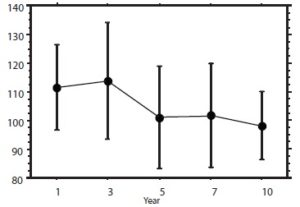
A Second Pregnancy may Possibly Worsen the Course of IgA Nephropathy – Ten Year’s Experience in a Single Kidney Disease Center

Background:
Whether the long-term prognosis of IgA nephropathy is influenced by pregnancy is controversial.

Study Design:
A single center, prospective observational study.


View Full Article: HERE

Go through the Journal: http://www.enlivenarchive.org/nephrology-and-renal-studies-open-access

Contact Us: nephrology-renalstudies@enlivenarchive.org

Cytokine Gene Polymorphisms are Associated with Serum Levels of Cardiovascular Risk Markers in Renal Transplant Recipients

Introduction:
Cardiovascular disease represents the main cause of morbidity and mortality after renal transplantation. We have previously reported that functional cytokine gene polymorphisms affecting their expression and serum levels are candidates as potential cardiovascular risk factors in kidney transplant recipients. This study investigated the influence of cytokine production genotypes on the serum levels of the some well-assessed cardiovascular risk markers after renal transplant.


View Full Article: HERE

Go through the Journal: http://www.enlivenarchive.org/nephrology-and-renal-studies-open-access

Contact Us: nephrology-renalstudies@enlivenarchive.org


A Note on Change-Point Estimation in a Multinomial Sequence

We revisit the multinomial change-point problem posed by Riba and Ginebra relative to a putative change in authorship of Tirant lo Blanc. We utilize Lancaster partitions of chi-squared tests of homogeneity, as well as techniques suggested from cluster analysis, in our investigations. Our findings are largely congruent with those of Girón, Ginebra, and Riba, with strong evidence for two authors.


View Full Article: HERE

Go through the Journal: http://www.enlivenarchive.org/biostatistics-and-metrics

Contact Us: biostatistics-metrics@enlivenarchive.org

Reconstruction of the Facial Nerve in Pigs with Facial Nerve Allografts Wrapped in a Fibrin Scaffold Containing Fibroblasts Transduced with Adenovirus Encoding VEGF 156

Nerve allografts, which are nerves transplanted between genetically non-identical individuals of the same species, have been studied in experimental and
clinical works and seem to be an effective method for nerve reconstruction. We aim to evaluate the effects of VEGF-secreting scaffold holding fibroblasts
transduced with an adenovirus on the survival of facial nerve allografts in a model developed in pigs. We operated on 10 white large pigs using one of the
following surgical protocols: protocol I, 5 subjects receiving nerve allografts wrapped with a fibrin scaffold holding fibroblasts; and protocol II, 5 subjects
with nerve allografts wrapped in a scaffold containing fibroblasts transduced with adenovirus encoding VEGF 156. Statistically significant differences
were found by the Mann–Whitney test between protocols I and II for the number of neurofilaments, the number of vessels per field, the number of nerve
bundles, and the percentage of neural tissue, with the scores higher for protocol II subjects (p= 0.008 for the above variables). There were no differences
in the diameter of the nerve between the protocols. When Student’s t was used, the number of neurofilaments and the percentage of neural tissue were
significantly different (p= 0.002). This experiment showed that in pigs receiving a 4-cm facial nerve allograft, conditioning with adenovirus-mediated
VEGF-secreting heterologous fibroblasts embedded in a fibrin scaffold, improved axonal passage throughout the nerve allograft and helped to maintain
the continuity and structure of the new facial nerve.


View Full Article : HERE 

Go Through The Journal : http://www.enlivenarchive.org/surgery-and-transplantation

Contact Us : surgery-transplantation@enlivenarchive.org
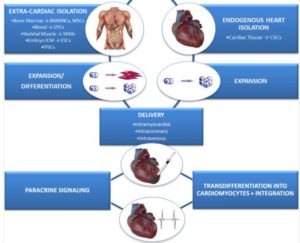
The State of Current and Future Therapies for Congestive Heart Failure: A Review

Heart failure is a significant cause of morbidity and mortality globally. An estimated 38 million patients suffer from heart failure worldwide, and its
prevalence is expected to increase. In Canada, 1% of the population suffers from heart failure and the number of admissions for this disease is expected
to increase 300% from 1996 to 2050. In the United States, the number of patients with heart failure is estimated to increase 25% by 2030 with an
estimated cost of $69.8 billion. Despite advances in modern medical care, heart transplantation remains the definitive treatment. Heart transplantation
has had progressive, improved success in survival due to improvements in immuno-suppression. However, the availability of donor organs remains
limited. Mechanical circulatory support has been an increasingly utilized option for patients with end-stage heart failure as bridge-to-transplantation, or
for permanent destination therapy, but multiple complications can occur. As an alternative, stem cell therapy has emerged as a promising new field for the
treatment for heart failure. It brings the possibility of regenerating new functional myocardium from donated or autologous cells. However, this field is still
in its early stages and clinical success has been modest, to date. This field may gain assistance by developments in nanotechnology and tissue engineering where patches, grafts, and even whole replacement organs may shape the future of heart failure therapy. We review the current and future states of these advancing technologies.


View Full Article : HERE

Go Through The Journal : http://www.enlivenarchive.org/surgery-and-transplantation

Contact Us : surgery-transplantation@enlivenarchive.org
The Place of Skin Cancer Screening in Heart Transplant Recipient Follow-Up Protocols: A Case Series

Objectives:
For solid organ transplant recipients the risk of skin cancer is markedly increased due to immunosuppression. Many studies propose an annual, or more frequent, skin screening program by a dermatologist. As the number of transplant recipients increases and survival times improve, the need for screening and rapid response (as required) access is increasing.


View Full Article : HERE

Go Through The Journal : http://www.enlivenarchive.org/surgery-and-transplantation

Contact Us : surgery-transplantation@enlivenarchive.org