The Journey of Trauma from Kashmir Valley

We are all aware and fresh with the memories of the recent turmoil that shook us to shambles last year and is still chasing us in Kashmir valley. Trauma is not something new for us as we have been already handling all varieties of trauma since last three decades. Trauma is growing menace and is listed as one of the major killer diseases of the mankind, assuming a significance of a global disease. Trauma is engulfing and mopping up human lives in its different facies. Natural catastrophes like earthquakes, floods, avalanches, land-slides, fire outbreaks, tsunamis consume human lives in bulk and bring massive destruction and devastation. Over the last few decades yet another form of trauma has cropped up globally owing to urbanisation. The road traffic accidents is yet another challenge to handle. Man to man conflicts, war weaponry have explored a newer horizon of trauma. According to a recent WHO report you will be surprised to know that by 2020 trauma will be the third largest killer disease in the developing world. It is going to be the global pandemic. Rapid urbanisation, industrialisation, crimes and violence have led to an alarming increase in the rate of accidental injuries. It is estimated that in the developing countries over 6 million will die and 60 million will be injured in the next 10 years. Road traffic accidents are increasing at an alarming annual rate of 3%. It may not surprise you to know that a vehicular accident is reported every 3 minutes and a consequent death every 10 minutes on Indian roads. A trauma related death occurs in India every 1.9 minutes. It is alarming to note that the magnitude of the problem is growing and growing and little has been done in this regard to handle this meanace.


VIew Full  Article : HERE

Go Through The  Journal :  http://www.enlivenarchive.org/surgery-and-transplantation

Contact Us : surgery-transplantation@enlivenarchive.org
 

Laparoscopy- An Overview

The art of surgery has undergone a massive metamorphosis over the past few decades. From open surgery to minimal access surgery and laparoscopy, surgeons have geared up with numerous techniques that have become gold standards for different operating procedures. Owing to constant research for better techniques, modifications and innovations in the field of laparoscopic surgery, operating on a patient has become a pleasure for both the doctor and the patient.


View Full Article : HERE

Go Through The Journal : http://www.enlivenarchive.org/surgery-and-transplantation

Contact Us : surgery-transplantation@enlivenarchive.org


Trends in Heart Transplantation

The first heart transplant was performed in 1966 by Christian Bernard in South Africa, remained relatively unknown until the development of more effective anti-rejection drug regimens in 1970s and 1980s. The current indications for heart transplantation are patients with severely impaired left ventricular function, intractable angina, unmanageable arrhythmias and severe diastolic failure.


View Full Article : HERE

Go Through The Journal : http://www.enlivenarchive.org/surgery-and-transplantation

Contact Us : surgery-transplantation@enlivenarchive.org


Uphill Battle on the Paradigm Shift on the Targets of Human Chorionic Gonadotropin/ Luteinizing Hormone Actions

Uphill battles have always been fought whenever there are paradigm shifts. It is no surprise then that it had to be fought when a body of work from around the world forced a paradigm shift on the targets hCG/LH actions. These hormones are structural and functional homologs that are believed to regulate only male and female gonads. In addition, hCG, which exists in humans and subhuman primates, was believed to be required only for about the first 9th weeks of pregnancy, even though low circulatory levels are present during the entire pregnancy. These two concepts have been forced to change, i.e. hCG and LH can also regulate many nongonadal tissues and hCG may be required throughout pregnancy in women.


View Full Article: HERE

Go through the Journal: http://www.enlivenarchive.org/gynecology-and-obstetrics

Contact Us: gynecology-obstetrics@enlivenarchive.org


The Proactive Pharmacovigilance Clinical Pharmacist: Is it Specialty of its Own

The World Health Organization (WHO) defines pharmacovigilance as “the science and activities relating to the detection, assessment, understanding and prevention of adverse affects or any other possible drug-related problems.”


View Full Article: HERE

Go through the Journal: http://www.enlivenarchive.org/pharmacovigilance-and-drug-safety-open-access

Contact Us: pharmacovigilance-drugsafety@enlivenarchive.org


The Role of Pharmacy and Therapeutic Committees in Pharmacovigilance and Drug Safety

The healthcare facilities must have a system incorporated in order to detect, monitor, prevent and report any unsafe use of pharmaceuticals and to track the launch of newer ones. This tracking system can be achieved via the pharmacy and therapeutics committee (PTC) that represents the governing body of pharmaceuticals within any healthcare facility.


The PTC role-functioning is to establish proactive subcommittees for medication safety and drug utilization evaluation. These subcommittees within their term of references can expand their activities and draw action plans for each quarter and evaluate pattern of use of pharmaceuticals across their facilities. Furthermore, their action plan should state clearly the steps to be taken to run post-marketing surveillance for specific drug entities (to elucidate their potential risk) such as biologics, new oral anticoagulants (NOACs), Anti-platelets, anticonvulsants, antidepressants, antipsychotics, antibiotics, insulin, anti-diabetics, heparins, and any drug that poses potential risk to patients. In the absence of system in place, no reporting will take place and no clinical judgment can be obtained on these high-alert drugs.

This role can be strengthened with pharmacovigilance tailored-research. Whereby, real population (not just similar) will be exposed to the drug on hand and specific conclusions pertaining to that population can be drawn and acted upon accordingly. We need more recognition of clinical pharmacists, as they are the most expert clinicians in this field. Supporting this role by organizational policies and bylaws can bring more safety-culture to our patients.

The clinical pharmacists representing the PTC can oversee all safe, economic and rational use of pharmaceuticals across the healthcare facility. The need for clinical pharmacists as leaders in the pharmacy profession will streamline these functions and ensure that pharmacovigilance principles and safe drug use are both in place.


View Full Article: HERE

Go through the Journal: http://www.enlivenarchive.org/pharmacovigilance-and-drug-safety-open-access

Contact Us: pharmacovigilance-drugsafety@enlivenarchive.org


Pharmacovigilance and Drug Safety

This is both challenging and exciting to write an editorial for the journal Pharmacovigilance and Drug Safety. The number of medicines in the market has increased dramatically over the last few years, bringing some real innovations, but also considerable challenges in controlling the quality and rational use of medicines. Safety of medicines is an important issue. Due to intense competition among pharmaceutical manufacturers, products may be registered and marketed in many countries simultaneously. As a result adverse effect may go unnoticed and so are not monitored systematically. Pharmacovigilance is a structured process for the monitoring and detection of adverse drug reactions in the given context.


This is both challenging and exciting to write an editorial for the journal Pharmacovigilance and Drug Safety. The number of medicines in the market has increased dramatically over the last few years, bringing some real innovations, but also considerable challenges in controlling the quality and rational use of medicines. Safety of medicines is an important issue. Due to intense competition among pharmaceutical manufacturers, products may be registered and marketed in many countries simultaneously. As a result adverse effect may go unnoticed and so are not monitored systematically. Pharmacovigilance is a structured process for the monitoring and detection of adverse drug reactions in the given context.


The motive of drug companies in production of new pharmaceutical product is the maximization of profits. Production and distribution of counterfeit medicines is acknowledged to be another problem of great magnitude in many developing countries.


In the era of globalization and information explosion, it has become critical to safeguard the patients from the side effects of drug. Due to ignorance of patients, it has become mandatory to teach and correct every drug you prescribe to a patient. Concern about adverse effects and drug interaction has increased worldwide. At this juncture the journal titled ‘Pharmacovigilance and Drug Safety’ sets a new paradigm for pharmacy practice. The journal focuses on Pharmacovigilance and and has role in protecting the patients from undesirable drug effects and drug related problems by publishing research articles of high standard.


This international journal is open access, peer reviewed and first issue has been released successfully. Mission of the journal is to become most popular open access journal in the field of science by publishing high quality articles. The journal also aims to report innovative, evidence based research articles related to pharmacology, drug delivery etc ,which will further contribute to the advancement of Pharmacovigilance.


We look forward to publish articles of good scientific merit and invite researchers across the globe to be a part of our mission by contributing valuable articles to the journal.


View Full Article: HERE

Go through the  Journal: http://www.enlivenarchive.org/pharmacovigilance-and-drug-safety-open-access

Contact Us: pharmacovigilance-drugsafety@enlivenarchive.org


Role of Pharmacovigilance in Drug Development

Pharmacovigilance (PV) is the science and activities relating to the detection, assessment, understanding and prevention of adverse effects or any other drug related problem. PV collects, records, codes ADEs/ADRs analyses and assesses the reports, promotes the safe use of drugs, creates appropriate structures and means of communication needed to perform its tasks. The aims of PV are to improve patient care and safety, improve public health and safety, contribute to the assessment of benefit, harm, effectiveness and risk of medicines, promote education and clinical training, promote effective communication to public and promote rational and safe use of medicines.


The process of drug discovery and development is a long-term, competitive, expensive and complicated process. Bringing the drugs from the bench to the market, that is, from screening and identification of the drug as a compound to its introduction to the market, takes several years of efforts [1].The process of discovering and developing a new drug involves an intricate interaction between investors, industry, academia, patent laws, regulatory authorities, marketing and the necessity to balance confidentiality with communication [2]. The complete process of presenting a drug to the patients involves four stages- 1. Drug discovery, 2. Drug development, 3. Regulatory review and approval, and 4. Marketing [3].


View Full Article: HERE

Go through the Journal: http://www.enlivenarchive.org/pharmacovigilance-and-drug-safety-open-access

Contact Us: pharmacovigilance-drugsafety@enlivenarchive.org


GATA4 Novel Role in Dilated Cardiomyopathy: Is the Drastic Zinc Finger Mutation Hiding a Non-DNA Binding Role for Zinc Finger Transcription Factors?

GATA4 is a transcription factor that belongs to the GATA family of zinc finger proteins, which are expressed in various organs during mammalian
development including the hematopoietic system, the heart, the gonads, the lungs, and the kidneys. All vertebrate GATA family members have
two zinc finger domains. The C-terminal finger serves as a DNA-binding domain and an interface of interaction with other transcription factors such
as NKX2.5 and TBX5. The N-terminal domain, which is thought to have been acquired by duplication of the C-terminal domain through evolution,
helps in stabilizing the binding to the DNA, and so far has been implicated in the physical interaction with the Friend of GATA (FOG) zinc finger proteins.


View Full Article: HERE

Go through the Journal: http://www.enlivenarchive.org/genetic-molecular-and-cellular-biology

Contact Us: genetics@enlivenarchive.org


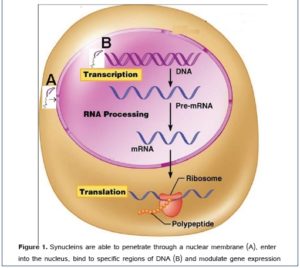
Synucleins: What do they do in the Nucleus?

Synucleins are small (113–143 amino acids) proteins expressed primarily in neural tissue. The family consists of three proteins: α -synuclein, β -synuclein,
and N-synuclein with high amino acid sequence similarity at the N-termini and variable C-termini. All synucleins have in common a highly conserved
alpha-helical lipid-binding motif.

View Full Article: HERE

Go through the Journal: http://www.enlivenarchive.org/genetic-molecular-and-cellular-biology

Contact Us: genetics@enlivenarchive.org