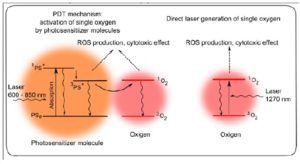
Infrared quantum-dot laser diode irradiation (1268 nm) was observed to induce irreversible oxidative stress in cancer cells through direct triplet→singlet oxygen transition designating a novel cancer treatment equally with photodynamic therapy, PDT (Sokolovski, et al. Sci. Rep. 3:3484, 2013). A single laser pulse induction of reactive oxygen species (ROS) was attended with Ca2+ release and coupled ROS and Ca2+ sustained activation occurs far beyond the initial laser pulse exposure. Cancerous cells (HeLa) were observed to be more sensitive to laser-induced ROS generation then normal keratinocytes. The developed model of the laser-induced oxidative stress showed that the main impact on the cell oxidative state makes a cascade of secondary ROS triggered by primary laser-induced singlet oxygen and irreversible depletion of cellular antioxidant system in cancerous cells. We proposed the model of the amplification of laser-induced ROS generation due to the coupled ROS and Ca2+ activation through endoplasmic reticulum (ER) and mitochondria crosstalk.
View Full Article: HERE
Go through the Journal: http://www.enlivenarchive.org/bioinformatics-open-access
Contact Us: bioinfo@enlivenarchive.org