Objective
To evaluate early echocardiographic variables of neonates with alveolar capillary dysplasia (ACD).
Study Design
A case-control study of five neonates with ACD and their matched controls on extracorporeal membrane oxygenation from 2000-2011. Two cardiologists prospectively reviewed first admission echocardiograms. Statistical tests included Kappa, T-test, Mann-Whitney, Fisher’s exact, and Chi-square analysis.
Results
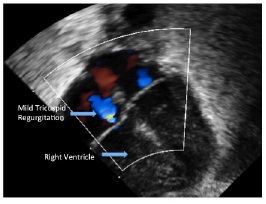
Excellent inter-rater reliability readings were achieved (Kappa 0.75-1). Tricuspid regurgitation (TR) velocities between the groups were not statistically significant; all ACD cases and 75% of the controls had TR velocities ≥ 3.2 m/sec. More ACD cases had moderate-severe TR jet (80% vs. none, p<0.01); moderate-severe right atrial enlargement (RAE) (100% vs. none, p<0.01); moderate-severe right ventricular (RV) dilatation (100% vs. none, p<0.01); and moderate-severely depressed RV function (60% vs. none, p<0.01). ACD patients were 12 times more likely to have a combination of moderate-severe RAE and moderate-severe TR jet compared to controls (OR = 11.6 [2-68]).
Conclusion
The combination of moderate-severe RAE and TR jet unresponsive to maximal interventions should alert clinicians of the possibility for ACD. We speculate that early echocardiographic predictors may identify at-risk neonates with fatal ACD and lead to early consideration of lung transplant.
View Full Article: HERE
Go through the Journal: http://www.enlivenarchive.org/anesthesiology-open-access/
Contact Us: anesthesia@enlivenarchive.org