Predictors of Outcome in COPD Patients with Hypercapnic Respiratory Failure Requiring NIV

Background and Objectives:

Delay in identifying patients in whom NIV will be unsuccessful may postpone endotracheal intubation, increasing morbidity and mortality. Aim of this study was to determine factors associated with NIV failure in patients with COPD exacerbations.

Methods:

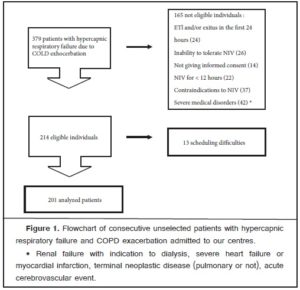
We retrospectively evaluated COPD patients with acute respiratory failure due to an acute exacerbation, undergoing NIV for at least 12 hours. Univariable analysis was performed on: age, gender, APACHE II, GCS, gas exchange at admission, during NIV and at discharge/death, length of stay. A ROC curve for the variable pH START (arterial pH value at admission) was performed and sensitivity,specificity, likelihood ratios and confidence intervals, were calculated.

Results:

Among 201 enrolled individuals, NIV failed in 50 subjects, leading to invasive ventilation and/or death. NIV succeeded in patients with: lower APACHE II (20.02±4.81 in succeeding group vs 24.84±6.35 in failing group, p<0.001) and PaCO2 at admission (93.10±15.08 vs 98.45±16.09, respectively, p=0.029) and after 2-4 hours of NIV (77.62±13.62 vs 82.12±15.24, respectively, p=0.044), and higher pH at admission (7.26±0.06 vs 7.23±0.08, respectively, p=0.033), and GCS (12.94±2.44 vs 11.24±3.32, respectively, p=0.001).

No variable was found to be able to predict NIV failure in patients with pH START >7.20 and ≤7.25, despite the high percentage of successes observed in this subset of individuals (81%).

Conclusion:

Further multicentric studies are needed to better define NIV indications, with special reference to pH thresholds.

View Full Article:  HERE

Go through the  Journal: http://www.enlivenarchive.org/anesthesiology-open-access/

Contact Us: anesthesia@enlivenarchive.org
 

Plateau Waves, Intracranial Hypertension and Prognosis. How Identical Waves can Lead to Different Outcomes in Two Patients with Traumatic Brain Injury

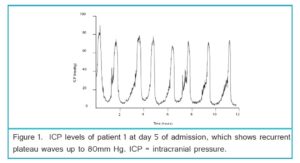
Elevated intracranial pressure (ICP) can lead to secondary brain damage and is associated with worst outcome in patients with traumatic brain injury. We present two clinical cases of high ICP due plateau waves. This, frequently occurring cause of high ICP, can cause confusion at the bedside if not recognized. High ICP due to plateau waves has a different prognostic implication and treatment algorithm compared to other causes of high ICP. We describe the pathophysiology and management of this phenomenon.

View Full Article: HERE

Go through the Journal: http://www.enlivenarchive.org/anesthesiology-open-access/

Contact Us: anesthesia@enlivenarchive.org
IABP: The Show Goes on but All that Glitters is not Gold

Despite remarkable improvements in early diagnosis and treatment of acute myocardial infarction (AMI), cardiogenic shock is still the most common cause of in hospital mortality and morbidity associated with AMI, which occurs in about 7% of these patients.

The intra-aortic balloon pump (IABP) has long been widely recognized as the most promising and effective mechanical haemodynamic support device . The IABP is a catheter-mounted balloon positioned in the descending aorta, usually through a percutaneous femoral approach. Counterpulsation is achieved by rapid inflation in the diastole and deflation in systole of the balloon synchronised to the cardiac cycle.

View Full Article: HERE

Go through the Journal: http://www.enlivenarchive.org/anesthesiology-open-access/

Contact Us: anesthesia@enlivenarchive.org
 

Left Ventricular Assist Device and Resident Cardiac Stem Cells in Heart Failure: Human Heart’s Potential Matter

Heart disease is the leading cause of mortality in Western countries, accounting for 17.3 million deaths per year. The impact of cardiovascular diseases is influenced by the ability to treat and assist patients surviving acute myocardial infarction (AMI), which has resulted in a nearly epidemic of chronic heart failure (HF), with roughly 5.8 million people with this diagnosis and about 500,000 new cases every year in the U.S.A. Irrespective of the etiology and despite the fact that recent advances in medical and surgical treatments of HF have led to better treatments, 50% of patients die within a month after AMI, and 50% of those with severe HF die within a year. From a pathophysiologic point of view the hemodynamic overload generated by AMI imposes mechanical and neurohormonal challenges on cardiac walls, initially triggering compensatory left ventricular hypertrophy, but eventually activating complex biological responses evolving into maladaptive remodeling, untreatable with conventional therapy.

View Full Article: HERE

Go through Journal: http://www.enlivenarchive.org/anesthesiology-open-access/

Contact Us: anesthesia@enlivenarchive.org
 

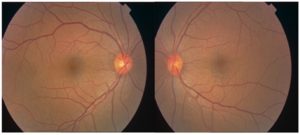
Topiramate Induced Bilateral Simultaneous Angle Closure Glaucoma in A Steroid Responde

To report a case of topiramate induced bilateral simultaneous angle closure glaucoma in a young male patient who also developed steroid response following conventional treatment ie, cessation of the causative drug (Topiramate),topical and oral steroids along with antiglaucoma medication. There was an initial drop in Intra-ocular Pressure (IOP) subsequently followed by a secondary rise in IOP due to steroid response despite the resolution of topiramate induced bilateral ciliochoroidal effusions.

View Full Article: HERE

Go through the journal: http://www.enlivenarchive.org/clinical-ophthalmology-research

Contact Us: clinicalophthalmology-research@enlivenarchive.org

Can Conjunctival Impression Cytology be the First Line Diagnostic Test for Evaluation of Dry Eye Syndrome?

Purpose: To determine how Conjunctival Impression Cytology (CIC), Schirmer test, Tear Film Break up Time (TBUT) and Rose Bengal Stain (RBS) correlate with dry eye symptoms. To calculate the sensitivity, specificity and likelihood ratio (LR) of these tests for diagnosis of dry eye.

Methods: A case control study was done at two referral eye centers in northern part of the Indian subcontinent. Symptomatic patients with dry eye were recruited based on their response to a questionnaire of dry eye related symptoms (Table 1). Age and sex matched healthy subjects served as controls. Sensitivity and specificity, as estimated by the area under receiver operating characteristic (ROC) curve were primary outcome measures and the correlation between dry eye symptoms (DESS) and ocular surface tests, were secondary outcome measures.

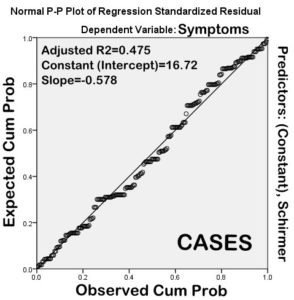
Results: Eyes of 320 symptomatic patients were compared to 350 eyes of age and sex matched healthy controls. The mean symptom score in cases and controls was 8±2.6 and 1.2±2, respectively (P<0.001). The diagnostic accuracy of these tests was CIC (AUC=0.957) >TBUT (AUC=0.793)>Schirmer (AUC= 0.765)>RBS (AUC=0.723). There was a stronger correlation between symptoms, CIC (Pearson’s coefficient, Adjusted R2=0.774) and TBUT (R2=0.580). However, the correlation of RBS (R2=0.361) and Schirmer (R2=0.475) with dry eye symptoms although positive, was less significant (R2<0.5).

Conclusions: CIC correlates best with dry eye symptoms and has excellent specificity and sensitivity in diagnosing dry eye as compared to other tests evaluated in the study.


View Full Article: HERE

Go through the journal: http://www.enlivenarchive.org/clinical-ophthalmology-research

Contact Us: clinicalophthalmology-research@enlivenarchive.org


Visual and Anatomic Outcomes in Eyes with Idiopathic Juxtafoveal Macular Telangiectasia (MacTel) and Full Thickness Macular Holes Undergoing Surgical Repair

Purpose: To report visual and anatomic outcomes in eyes with idiopathic juxtafoveal telangiectasia (MacTel) type 2 undergoing small gauge vitrectomy surgery with gas tamponade for full thickness macular holes (FTMH).

Methods: Medical records of all adult patients with the diagnoses code for retinal telangiectasia were reviewed. Preoperative and postoperative data were obtained including visual acuity and OCT imaging. These cases were then compared with historical controls that also underwent surgical repair.

Results: Between the years of 2003-2013 34 patients met the inclusion criteria. Of the 34 patients, only 4 patients developed a FTMH. Of the 4 patients, 2 underwent surgical repair. Of these surgical cases one hole closed and one hole remained open at final follow-up.

Conclusion: In our cases of FTMH in patients with MacTel type 2, we had mixed results with hole closure and preservation of visual acuity. When adding our cases to the current cases in literature, the hole closure percentage is 47% with stabilization of visual acuity with or without surgical repair. It seems reasonable in these cases to observe unless visual acuity is significantly diminished.

View Full Article: HERE

Go through the journal: http://www.enlivenarchive.org/clinical-ophthalmology-research

Contact Us: clinicalophthalmology-research@enlivenarchive.org


Ophthalmological Societies in USA: An Overview

This is a concise overview in a table format for the current non-profit membership-based ophthalmological societies in USA. These societies played a major role in continuous medical education. There is a clear need for establishing more societies which focus on different aspect of ophthalmology. There is always a potential for improving the benefits of these societies to the professionals and to the public. Social media might be utilized in achieving some of the functions of these societies.

View Full Article: HERE

Go through the journal: http://www.enlivenarchive.org/clinical-ophthalmology-research

Contact Us: clinicalophthalmology-research@enlivenarchive.org


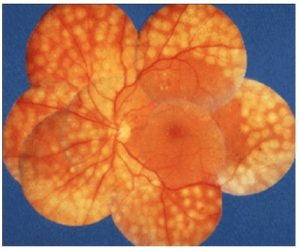
Rods, Dark Adaptation, and the Development of Diabetic Retinopathy

There is a pandemic of diabetes. More than 350 million people are affected world-wide. In the UK more than 4.2 million people (6.3% of the population) are estimated to be living with diabetes, many without even knowing it. In the USA 29.1 million ( 9.3% of the population ) have diabetes. Most individuals have type II diabetes the onset of which is strongly attributed to the adoption of a “western diet” rich in calories from refined carbohydrates and saturated fat. But type I diabetes is also increasing. Furthermore, type II now appears at much earlier ages, even in children, and increasing numbers of people with type II are insulin dependent. Even with an estimated 150,000 people in the UK developing diabetes each year, the prevalence of very long standing diabetes is growing even more rapidly as individuals with diabetes are living longer than ever before. This sets up a perfect storm for complications of diabetes which develop after long periods.


View Full Article: HERE

Go through the journal: http://www.enlivenarchive.org/clinical-ophthalmology-research

Contact Us: clinicalophthalmology-research@enlivenarchive.org

Efficacy of the Selective Laser Trabeculoplasty in Exfoliation and Primary Open-Angle Glaucoma

Purpose: This is comparative study for evaluation of the efficacy and lastingness of intraocular pressure (IOP) reduction of selective laser trabeculoplasty (SLT) in exfoliation (EG) and primary open-angle (POAG) glaucoma.

Methods: 48 patients with EG and 48 with POAG were recruited to the study. The angle grade 3 and 4, by Shaffer, were considered to be open. Trabecular meshwork (TM) pigmentation was graded from 0 = no pigmentation, to 4 = dense pigmentation. TM was treated with a 532-nm frequency-doubled, Q-swiched Nd:YAG laser, energy ranged from 0.7 to 2.0 mJ. IOP were measured during one year follow-up.

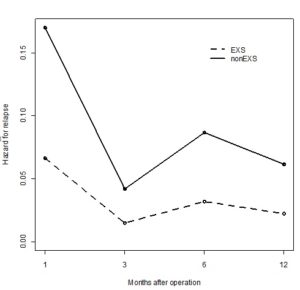
Results: Patients in the EG group were older than in POAG group and had significantly more pigmented TM. The mean baseline IOP in the EG group was 24.1 (± 4.5) and 23.7 (± 3.3) in the POAG group and in the end of the one-year follow-up 18.6 (± 3.7) and 18.4 (± 2.5) mmHg respectively with no significant difference between two groups. The 12-month success rate was 87.3% and 69.7% in the EG and POAG patients, p= 0.05. Interaction between exfoliation syndrome (EXS) and the energy of the laser, not the level of TM pigmentation was significant predictor of the IOP rise during the follow-up. The odds of a relapse are 2.98 times lower for patients with EXS.

Conclusions: SLT is effective and reduction of IOP is long-lasting in EG and POAG patients. Exfoliative material independently from TM pigmentation seems to have influence to results of SLT.

View Full Article: HERE

Go through the journal: http://www.enlivenarchive.org/clinical-ophthalmology-research

Contact Us: clinicalophthalmology-research@enlivenarchive.org